Daguerreotype
 · "L'Altelier de L'Artiste" by Daguerre (1837)
The photo is in black and white. As you can see, there’s a
wooden horse on the right side. There’s two heads of angels, you can usually
see those at churches. There’s amphora above the heads of those angels. Amphora
is related to ancient Greek. They had this during the Bronze Age in ancient
Greek. There’s like a photo frame of Venus. About the Venus photo frame like, I
don’t know if it is related with the Venus of ancient Greeks. They had this arm less
Aphrodite and they called it Venus de Milo. Because if this Venus is related to
ancient Greeks, this photo is about the ancient Greeks. There’s also a horse
which is also related to ancient Greeks. They called it as Trojan Horse. Daguerre
is a Frenchman.

· "Boulevard du Temple" by Daguerre (1838)
This photo is in black and white, too. It’s a cityscape. You can see skyscrapers, maybe hotels or two-storey or three-storey houses. I used the rule of thirds in this photo and the focal point or the point of interest is the chimney part of that building (front, right side). This photo is also an example of wide shot or establishing shot. And you can see repetition in this photo. The repetition of trees, chimneys, light posts, windows and if you’re to look closer in the right side there’s a repetition of the fence.
.jpg)
· “United States Capitol" by Daguerre (1839-1862)
In this photo you can see that the
photographer used a repetition and establishing shot. You can see the
repetition of the posts, windows, trees, the patterns in the roof and the
staircase. I used rule of thirds in this photo and the focal point is the middle
part of this building, which is the triangle-ish roof (the entrance part).

· · “Duke of Wellington" by Antoine (1844)
This is a daguerreotype of Duke of
Wellington. I noticed the repetition of those buttons in his top. This photo is
also an example of mid-shot. When I used the rule of thirds in this photo, the
focal point is from his nose bridge down to above of the first button. The
background colour makes it interesting. And I noticed that the duke is not
looking at the camera, he’s looking at the left side and it makes more
interesting.
Rayogram or Photogram

· “Man Ray's Rayogram"
This rayogram is one of Man Ray's work. Well according to him, he photograph things that he doesn't want to paint, those things which already have an existence. And as I can see in this photo, I couldn't even tell what he's trying to show. It's like a satellite thing. The top part looks like a watch, because I can see those clock hands. But the rest, it's really hard to tell.
 · “Rayogram 1" by Lazy-Photo (devianart)
This is a rayogram of light bulbs and electrical wires. S/he used a repetition. The repetition of light bulbs (same kinds) and the repetition of electrical wires. This rayogram looks interesting because those electrical wires made a cool effect with the light bulbs. They're like moving electrical wires.

· “Rayograph" by Man Ray
Another rayogram made by Man Ray. He used a repetition in this rayogram. You can see the repetition of buttons, the circular thing of a spring, that thing at the right corner that formed a flower and lines. Just noticed that most of the photos that I've searched used the repetition.
 · Another Rayogram by Man Ray
This another Man Ray's work. And he used repetition again. The repetition of those little squares in the film strip, those string at the right side and that circle thing.
Photomontage

· "Skeleton" by Nancy Sutor (1982)
This is a photomontage of a skeleton and human body. Repetition is used in this photomontage, the repetition of the rib cage, that pattern in the spinal chord, nerves and abs (?). And we can tell that it's all about Science.
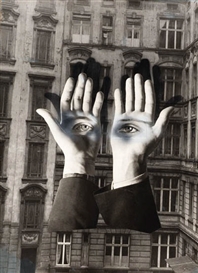 · "Lonely Metropolitan" by Herbert Bayer
In this photomontage repetition is used again. The repetition of the windows. And this photo looks interesting because of eyes in human hands. Those eyes look lonely and so as the background. The shadows of hands make it lonelier.

· No title photomontage by Thomas Barbey
This photomontage makes an optical illusion! It looks like that the building is in the wrong way that makes it look like a floating building. Repetition is seen in this photo (the windows, clouds and the circular posts).

· Churchchaislelg1204 by Brian Walker
This photomontage confused me. Because it's a church but in the middle there's like a city (o.o). Repetition is used again. The repetition of chairs, light posts and at the altar. This photomontage is really interesting! Because there's a city in the middle of the church. Like seriously, how come there's city in the middle of the church? That's impossible but this photo looks amazing!

No comments:
Post a Comment